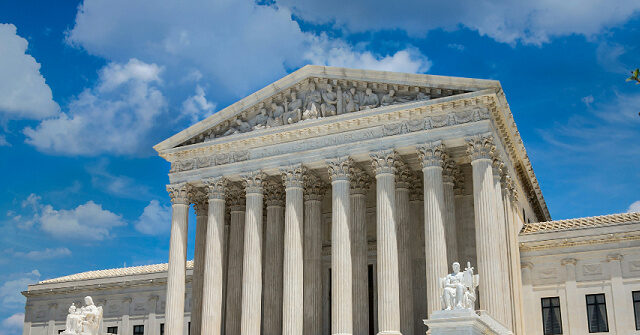
The Supreme Court of the United States (SCOTUS) rejected a request from Virginia Democrats for the nation’s high court to intervene after the Virginia Supreme Court ruled to strike down a gerrymander scheme that would have redrawn the state’s congressional map in favor of Democrats.
In an order on Friday, the U.S. Supreme Court’s rejection had “no dissents,” NBC News reported.
Virginia Gov. Abigail Spanberger (D) responded to the rejection by claiming that the Court had “joined the Supreme Court of Virginia in choosing to nullify an election.”
“The Supreme Court of the United States has now joined the Supreme Court of Virginia in choosing to nullify an election and the votes of more than three million Virginians,” Spanberger wrote in a post on X. “These Virginians made their voices heard — casting their ballots in good faith to push back against a President who said he’s ‘entitled’ to more seats in Congress before voters go to the polls.”
The rejection from SCOTUS came after Democrats such as Virginia Attorney General Jay Jones (D) and Virginia Solicitor General Tillman Breckenbridge issued an emergency application for a stay on Monday of the Virginia Supreme Court’s ruling.
In the filing, the Virginia Democrats claimed that the state’s Supreme Court was “deeply mistaken on two critical issues of federal law.” The first critical issue is that the Virginia Supreme Court had “predicated its interpretation” of the state’s Constitution on a “grave misreading of federal law”:
The officials continued to argue that the Virginia Supreme Court “is deeply mistaken on two critical issues of federal law,” one being that it “predicated its interpretation” of the state’s Constitution on a “grave misreading of federal law,” regarding election day being “a single day.” The second was that the Virginia Supreme Court had “arrogated to itself the power vested in the state legislature to regulate federal elections.”
The request from Virginia Democrats for the Supreme Court’s intervention came after the Virginia Supreme Court issued a 4-3 ruling, finding that the “legislative process” that was used to get the redistricting referendum in the state passed had violated Article XII, Section 1 of Virginia’s Constitution.
“On March 6, 2026, the General Assembly of Virginia submitted to Virginia voters a proposed constitutional amendment that authorizes partisan gerrymandering of congressional districts in the Commonwealth,” the court said. “We hold that the legislative process employed to advance this proposal violated Article XII, Section 1 of the Constitution of Virginia.”
In the ruling, the Virginia Supreme Court also explained that the “General Assembly must twice vote in favor of a proposed amendment at two separate legislative sessions with an intervening election of the House of Delegates.”
The ruling from the Virginia Supreme Court came after residents in Virginia voted in favor of the redistricting referendum, which would have changed Virginia’s current congressional districts from 6-5, to 10-1 in favor of the Democrats.