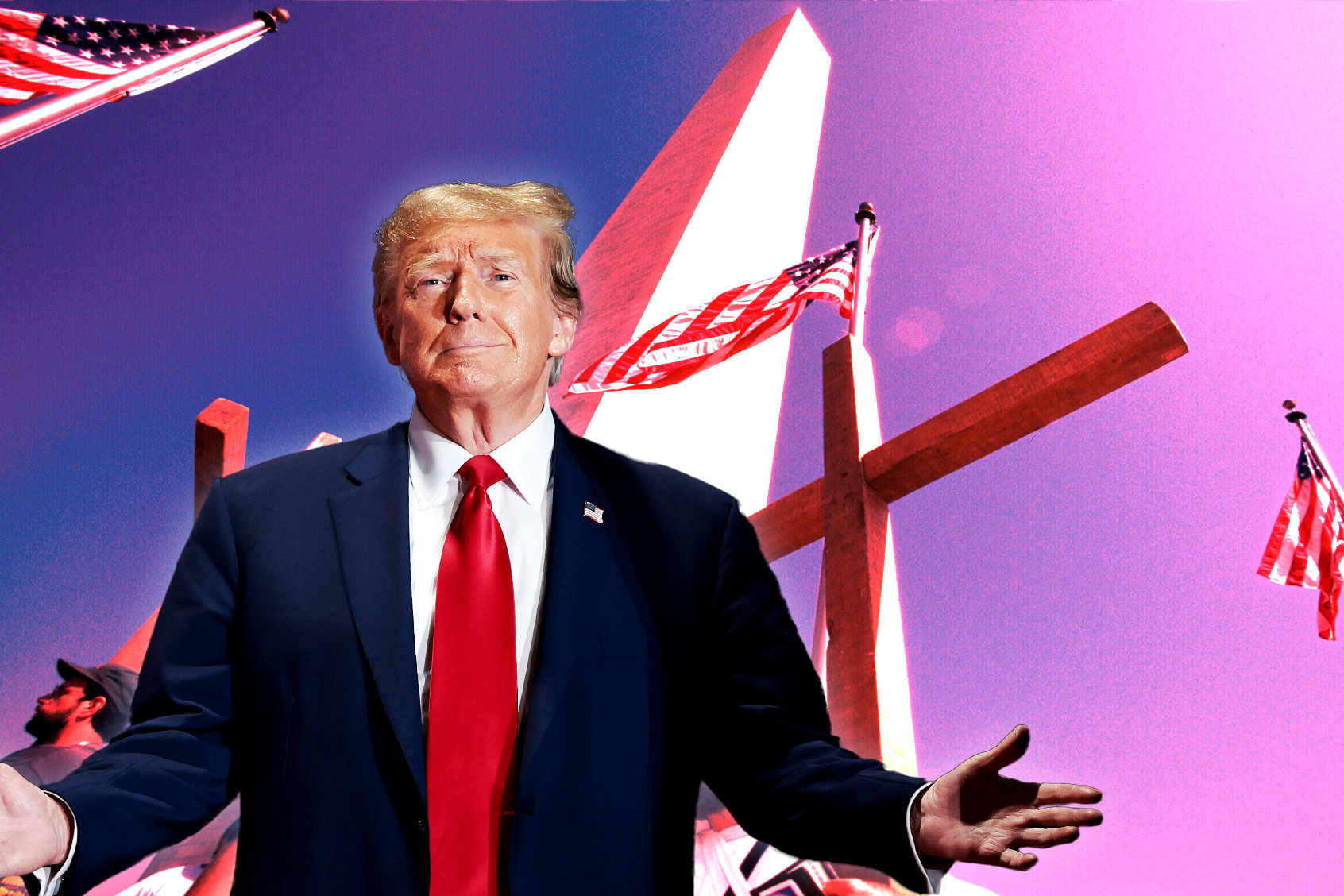
The most efficient campaign finance vehicle in American history is tax-exempt, requires no donor disclosure and is available in virtually every zip code in the country. For 70 years, it has operated under one rule: It cannot endorse a political candidate.
The Religious Liberty Commission, which delivered its report to President Donald Trump on June 26, would like to remove that rule. They’re calling it religious freedom.
As a Christian minister of an American Baptist congregation, I’ve spent more than 20 years in a pulpit — long enough to know the difference between protecting a church and conscripting one. A government that wants to free the church, to borrow Trump’s language, is usually trying to use it.
Since 1954, the Johnson Amendment has restricted churches, religious organizations and other tax-exempt nonprofits from endorsing political candidates or funneling tax-deductible donations into partisan campaigns. Pastors and faith leaders can preach on any moral or social issue, including justice, poverty, immigration, war. The only line is at the intersection of tax-exempt status and candidate endorsements. In other words, the amendment is the last structural barrier between the American church and full absorption into the machinery of partisan politics.
The claim that this constitutes religious suppression is the oldest con in the game. Every American pastor has the same First Amendment rights as any other citizen. What the Johnson Amendment restricts is tax-exempt dollars in partisan politics. Churches pay no federal taxes. In exchange, they stay out of the candidate-endorsement business. Void it, and that deal ends — and every church in America becomes a PAC with better branding and transparency requirements and endorsed by a divine mandate.
Here is how the mechanism would work — and in some places, already does. A donor writes a check to their congregation. Takes the full federal tax deduction. The church endorses the candidate of their choice, bundles contributions, runs voter registration drives for one party — and does all of it without the disclosure requirements that apply to actual political action committees. This is tax-exempt political spending, passed through the offering plate and invisible to the public record.
Since Trump promised at the 2017 National Prayer Breakfast to “totally destroy” the Johnson Amendment, churches that went all in on the MAGA model have provided a nine-year case study in what happens when a religious institution trades independence for political access. The flags of the nation and party beside the cross. The candidate’s name from the pulpit. The congregation sorted by loyalty to the pastor’s politics rather than anything resembling a common good.
Church attendance has collapsed at a pace that would have seemed impossible just a generation ago. According to a 2024 Pew Research study, the fastest-growing religious identity in America is “none.” The research on why people leave does not point to boredom or busyness. It points to disgust at what organized religion has become.
The Christian right has spent five decades getting closer to power and losing the one thing it cannot buy back: The credibility to speak to anyone outside its own coalition.
Our Summer sale is on!
The commission is not discouraged by any of this data. And their report does not even stop at the Johnson Amendment. It proposes replacing the principle of separation of church and state with what it calls “bridges between church and state.” In Trump’s Washington, “bridge” is apparently the new euphemism for “merger.”
The separation has existed because both institutions require protection from each other. When such safeguards are removed, the bridge comes with a toll booth, and the commission is waving one side through.
This is state power reinforcing evangelical Christianity, and evangelical Christianity legitimizing state power. The commission calls it “partnership.” History calls it a state church.
Without the Johnson Amendment, every offering plate in America becomes a campaign contribution box.
The stakes here are not merely theological. They are democratic. A fully politicized American church — operating tax-free, endorsing candidates, bundling political donations without disclosure — is not a more faithful institution. It is a more powerful one. Unchecked religious power fused to political authority, and with no structural wall left between them, is a problem for anyone who votes, pays taxes or prefers their government to represent the whole country rather than the congregation of whoever raised the most money last Sunday. Without the Johnson Amendment, every offering plate in America becomes a campaign contribution box.
Jesus was not being clever when he said in Matthew 22:21 “Give to the emperor the things that are the emperor’s, and to God the things that are God’s.” That verse has been cited in American political arguments for more than two centuries — usually by whoever needs it to mean something different. Christ was cornered — pay taxes to Rome, or be branded a traitor — and so he turned the trap into a statement about the limits of power. Caesar’s name is on the coin; give him the coin.
But not everything belongs to Caesar. Jesus was not brokering a deal between two powers. He was drawing the line past which no empire’s authority can reach. Empires have always wanted everything, including the sacred — especially the sacred — because religion is the oldest instrument for making political power look like it came from God. The commission has proposed erasing that line, rebranding the erasure as religious liberty and consecrating it in the Oval Office.
The commission’s report had a lot of words for this: “bridges,” “liberty,” “partnership.” The legal word is laundering.