Updated on: July 27, 2026 / 4:07 PM EDT / CBS News
U.N. experts on Monday called on Iran to cancel the death penalties given to 10 young men over antigovernment protests that rocked the country in January.
Twelve men, aged between their late teens and early twenties, were sentenced and two were executed on July 19.
"Sentencing 12 people to death in one hearing, in a closed courtroom and without clarity as to each defendant's individual responsibility violates established fair trial standards," the experts said.
The 13 experts are special rapporteurs of the United Nations and members of working groups on forced disappearances and arbitrary detention. But they do not speak on behalf of the world body.
The 12 young men condemned to death were accused of involvement in the death of four members of the security forces as well as acts of arson and vandalism during protests on Jan. 8 in Shahid Alikhani Square, Isfahan.
They were convicted based on televised confessions, the U.N. experts said.
"The charges against them remain unclear, as the Revolutionary Court hearings are closed and judgments are not published," they added.
Kazem Gharibabadi, Iran's deputy foreign minister for legal and international affairs, said Tehran rejected a U.S. proposal during recent negotiations in Islamabad, describing the proposal as containing "extreme demands." He insisted Iran made no attempt to keep the talks alive after Washington threatened to walk away.
Speaking at a conference for legal professionals, Gharibabadi said, "The U.S. side presented a proposal that reflected extreme demands. The Iranian delegation explicitly rejected this proposal."
According to Gharibabadi, "The U.S. side stated that if this proposal were rejected, the negotiations would be considered a failure and they would leave." He added that this is ultimately what happened, with the U.S. delegation ending the talks.
Gharibabadi stressed that "there was absolutely no insistence or pleading from the Iranian delegation to continue the negotiations, and this approach was an example of the Islamic Republic of Iran's 'dignified diplomacy.'"
The deputy foreign minister also addressed developments related to the Strait of Hormuz, saying that after Iran "once again closed the Strait of Hormuz following the crimes committed by the United States more than two weeks ago," talks were subsequently held in Oman.
He said, "The other side insisted that the southern route, which had been opened for ship traffic, remain open until the Iran-Oman negotiations reached a conclusion and only then be closed, but the Iranian delegation did not accept this proposal."
Gharibabadi added: "We explicitly declared that whatever the outcome of the negotiations, the principled policy of the Islamic Republic of Iran had been clear since the beginning of the war, and such proposals would not be accepted."
President Trump said he has a lot of patience and time for reaching a deal with Iran. He also said the Strait of Hormuz is in "very good shape," despite Iran's recent efforts to interfere with shipping through the key waterway.
The president said Iran requested to meet with the U.S. through surrogates and directly. A reporter asked the president how much patience he has for the situation right now.
"I have a lot of patience," Mr. Trump said. "I have plenty of time. Plenty of time."
He said they're having "good talks."
"I think there's a good chance that something could happen. And if it does, good, if it doesn't, we go back to doing what we were doing two days ago."
A reporter asked the president if he's received any indications from Saudi Arabia as to whether they will sign onto the Abraham Accords.
"We haven't talked about that," he responded.
Speaking to reporters aboard Air Force One, President Trump said the U.S. has plenty of munitions, following reports from CBS News and other outlets that the rapid pace that the U.S. is expending some of its most advanced air-defense interceptors and precision-guided weapons in the Middle East is a point of great tension inside the Trump administration, according to U.S. military and intelligence officials.
Officials told CBS News there are broader concerns about America's readiness for conflict in the future. A reporter asked the president if he's concerned about depleted stockpiles.
"No. We have plenty. We have a lot of ammunition. Different types," Mr. Trump responded. "You know, Biden gave a lot to Ukraine. And so we're building that up. But we have a lot. We have a lot of the mid-level stuff too. I mean, more than we could use no matter what. But we have a lot. I'd like to have more, to be honest. But so much was given to Ukraine by Biden. When I left, the cupboards were full."
The president said for some of the most sophisticated technology, the U.S. would like to have more supply.
The head of Iran's parliamentary national security commission warned Monday, in a social media post written in Ukrainian, that Ukraine could soon "come to understand that Iran does not leave its actions unanswered," following a Ukrainian attack on an Iranian commercial vessel over the weekend.
"Any attack on Iran always comes at a price, and this remains true today as well; the US and Israel are well aware of this. Ukraine may soon also come to understand that Iran does not leave its actions unanswered," the lawmaker, Ebrahim Azizi, wrote on X, adding that "the list of those who miscalculated continues to grow!"
Ukraine's President Volodymyr Zelenskyy said earlier Monday that he wanted to avoid opening a "new front" as his country continues battling to repel Russia's full-scale invasion, but he acknowledged a Ukrainian strike on Saturday that hit an Iranian commercial vessel in the Caspian Sea.
"We have to be careful. We have to do everything we can to not open a new front in any way," Zelenskyy told Britain's Sky News. "But we have to be honest: The Iranians and the North Koreans have already attacked us."
Iran's Foreign Ministry summoned the Ukrainian diplomatic representative in Tehran on Saturday to condemn the Ukrainian strike, which the ministry said killed one sailor and wounded another.
Iranian Foreign Minister Abbas Araghchi said Sunday that the attack "cannot go unanswered."
Mediators, led by Qatar and Pakistan, have made progress toward bringing the United States and Iran back to negotiations and restoring an interim ceasefire deal that collapsed in early July after exchanges of fire, The Associated Press reported Monday, citing two regional officials.
The AP cited one of the officials as describing the progress made in the mediation efforts as "significant."
The official said mediators were working with Iran and Oman on a mechanism to manage vessels' passage through the Strait of Hormuz, the flashpoint for the latest strikes and counterstrikes.
Iran's foreign ministry spokesman confirmed earlier Monday that talks with Oman were continuing, "focused on creating the necessary arrangements regarding the Strait of Hormuz."
Spokesman Esmail Baqaei noted that the discussions with Oman "may sometimes be subject to different interpretations," and he stressed that there was no direct dialogue between Iranian and U.S. officials.
By Mais Al-Bayaa and Tucker Reals
Speaking to Axios Monday, President Trump said there were "very deep talks" with Iran underway, but if they don't work, the U.S. will "go back to very strong military action."
Iran and Oman are talking about reopening the Strait of Hormuz, and regional sources told CBS News those talks are making some progress, though Tehran insists there has been no new direct dialogue with U.S. officials.
"We are in very deep talks with Iran," Mr. Trump told Axios. "If they don't work out, we will go back to very strong military action."
Axios asked the president how long he will give the diplomacy.
"Not much time," he responded. "Either it goes fast or not at all."
Bahrain's Ministry of Defense announced Monday that the small Persian Gulf state would conduct a joint military exercise this week with some of its neighbors, all of which have come under attack by Iran during the war with the U.S.
The "Bahrain Shield" exercise will run from Tuesday through Thursday, "with the participation of armed forces from fellow Gulf Cooperation Council (GCC) member states," the Bahrain Defense Forces said in a statement, adding that the drills would "improve combat performance levels."
Without specifying which of the six GCC member states would take part, the Bahraini military said the exercise would help strengthen "the cooperation framework and joint military coordination to face various challenges."
The last three days have seen no new strikes by Iran against U.S. allies in the Middle East, and the Trump administration has said it is giving diplomacy a chance amid talks between Iran and Oman aimed at reopening the Strait of Hormuz.
Prior to the current detente, however, Iran had attacked GCC members daily during a renewed round of fighting with the U.S., which began in early July as a ceasefire agreed to as part of a memorandum of understanding signed by President Trump and his Iranian counterpart crumbled.
According to the independent Institute for International Security Studies in Israel, Iran has targeted Bahrain with at least 70 weapons launches since the now-defunct U.S.-Iran ceasefire took effect in mid-June, and it was targeted with more than 700 Iranian weapons before the memorandum of understanding was signed.
The government of Qatar on Monday strongly condemned attacks by Iran-backed groups in Iraq "that attempted to target oil facilities in the Eastern Province and Riyadh regions of the sisterly Kingdom of Saudi Arabia using drones."
Saudi Arabia's military confirmed earlier that drones targeting oil infrastructure in the two locations were intercepted, causing no damage.
"The Ministry of Foreign Affairs affirmed the State of Qatar's full solidarity with the sisterly Kingdom of Saudi Arabia and its support for all legitimate measures it takes to safeguard its sovereignty, security, and territorial integrity," the Qatari ministry said in its statement, shared on social media.
"Israel's continued destruction of homes and bulldozing of villages in southern Lebanon constitutes a direct violation of human rights and a clear breach of international laws and norms," Lebanese President Joseph Aoun said during a meeting Monday with United Nations High Commissioner for Human Rights Volker Türk, according to a statement from the president's office.
"Israel has also targeted religious and heritage sites, demonstrating premeditated intentions against both people and property, especially since such sites are not military targets and do not host armed groups," said Aoun, calling for "international action to put an end to" the Israeli operations against the Iranian-backed group Hezbollah.
"Lebanon remains committed to implementing the 'Framework Formula,' but fears that Israeli practices will undermine its effectiveness, and it will not accept the continued violation of its provisions," he said, referring to a deal brokered by the U.S. between Israel and Lebanon.
Türk said the U.N. human rights office was monitoring developments in Lebanon, "particularly the continued Israeli attacks since March 2, in order to prepare a detailed report on violations affecting human rights," according to Aoun's office.
Saudi air defenses intercepted several drones launched from Iraq on Monday that were targeting petroleum facilities, Major General Turki Al-Maliki, the spokesperson for Saudi Arabia's Ministry of Defense, said in a brief statement shared on social media.
Al-Maliki said the "terrorist attempts were launched from Iraqi territory and carried out by terrorist militias affiliated with Iran," and he stressed the kingdom's inherent right to defend itself and to "respond at the appropriate time and place."
Iran has not launched drone or missile strikes on Saudi Arabia or other Persian Gulf states since U.S. forces paused their attacks on Iran on Saturday.
Israeli Prime Minister Benjamin Netanyahu told reporters before leaving for a visit to Washington on Monday that he would discuss with President Trump "all the issues on the agenda, primarily Iran."
"Our goal is to maintain our security and also expand the circle of peace around us," Netanyahu said. "I am embarking on this mission with one clear goal - to ensure the security, strength and future of our precious State of Israel."
Netanyahu, who will also attend the funeral of former U.S. Senator Lindsey Graham, said he would "pay my last respects to our friend, a true friend of mine and of the State of Israel."
Shipping through the Bab el-Mandeb Strait, the southern gateway to the Red Sea and a key maritime chokepoint like the Strait of Hormuz, dropped to its lowest level in months on Sunday after Iran's Houthi rebel allies in Yemen traded fire with Saudi Arabia, according to shipping intelligence firm Kpler.
The Houthis attacked oil installations along Saudi Arabia's Red Sea coast on Saturday and said their blockade of Saudi ports would remain in effect. The Houthis imposed their blockade last week in response to Saudi attacks on their infrastructure.
Traffic through the Bab el-Mandeb had increased last week, as an alternative route for energy products with the Strait of Hormuz largely gridlocked, but Sunday saw only 11 commodity ships transit the passage, which Kpler said was the lowest level in months.
The disruption to shipping through both straits caused oil prices to jump sharply last week, though the lull in fighting between Iran and the U.S. over the weekend has seen the cost of crude fall again.
Shipping traffic through the Strait of Hormuz has not rebounded.
Ukraine's President Volodymyr Zelenskyy said Monday that he wants to avoid opening a "new front" after Ukraine's military struck an Iranian commercial vessel in the Caspian Sea on Saturday.
"We have to be careful. We have to do everything we can to not open a new front in any way," Zelenskyy told Britain's Sky News on Monday. "But we have to be honest: the Iranians and the North Koreans have already attacked us."
Iran's Foreign Ministry summoned the Ukrainian diplomatic representative in Tehran on Saturday to condemn the Ukrainian attack on an Iranian ship, which the ministry said killed one sailor and wounded another.
Ukraine's security services said the target was "cargo ships that are subject to international sanctions and were used to transport military cargo between Iran and Russia."
Zelenskyy alluded to the attacks in a social media post, reporting "very good results from long-range strikes in the Caspian Sea."
Iran has supported Russia's war in Ukraine, selling drones including the Shahed-136 to Moscow. Russia has also been accused by U.S. officials of providing intelligence to Iran throughout the war launched jointly by the United States and Israel on Feb. 28, including targeting data on U.S. positions in the Middle East.
Zelenskyy warned Saturday that Russia could be increasing its support for Iran, and he promised to share evidence with the U.S.
"Since the beginning of July, we have recorded active Russian satellite surveillance of the Gulf states and U.S. military facilities located there," Zelenskyy said on X. "These images subsequently appear in Iran. At the same time, there is a clear correlation between Russia's satellite imagery of these sites and Iranian strikes — both before the attacks, in preparation for them, and afterward, to assess the damage inflicted."
Zelenskyy is expected to visit Washington this week, though neither his travel, nor a possible meeting with President Trump, have been confirmed.
World shares were mostly higher Monday and oil prices slipped nearly 7% as the U.S. and Iran refrained from fighting while discussing a possible resumption of negotiations on an interim ceasefire deal.
The Pentagon has not openly discussed the pause in attacks on Iranian coastal areas and infrastructure after nearly two weeks of escalating fighting, but U.S. Ambassador to the United Nations Mike Waltz said Sunday on "Face the Nation with Margaret Brennan" that it was aimed at "giving diplomacy some space."
Markets reacted with relief. U.S. futures surged early Monday and the price of a barrel of Brent crude, the international standard, dropped 6.8% to $85.49. U.S. benchmark crude dropped 7% to $83.06 per barrel.
"Oil's sharp retreat at the Monday open did more than knock a few dollars off the barrel. It loosened the geopolitical knot that had been tightening around equities, currencies, bonds and central banks for most of July," Stephen Innes of SPI Asset Management said in a commentary.
In early European trading, Germany's DAX gained 1.6% to 25,497.42 and the CAC 40 in Paris was up 0.8% at 8,436.94. Britain's FTSE 100 rose 0.5% to 10,784.00.
The futures for the S&P 500 and Dow Jones Industrial Average were up 1%.
Iran's foreign ministry denied on Monday any current direct negotiations with the U.S., but acknowledged ongoing talks with Oman aimed at finding an arrangement to reopen the Strait of Hormuz to shipping traffic.
"The discussions we have had over the past few days have been exclusively with Oman," ministry spokesman Esmael Baqaei told reporters in Tehran on Monday.
He said as the two countries with coastline in the strait, Iran and Oman were "trying to establish mechanisms regarding maritime traffic."
"We currently have no negotiations with the United States. The negotiations that we are having — and which may sometimes be subject to different interpretations — are the same negotiations that we are conducting with Oman, focused on creating the necessary arrangements regarding the Strait of Hormuz."
An Iranian official told CBS News' Margaret Brennan on Sunday that the talks between Iranian and Omani officials over the weekend were constructive, with discussions aimed at reopening the strait moving in a positive direction.
U.S. Ambassador to the United Nations Mike Waltz told "Face the Nation with Margaret Brennan" the pause was aimed at "giving diplomacy some space."
Waltz said the U.S. would gauge how things are going over the coming days, and he stressed that more U.S. military assets "are moving into the region," adding: "The regime should believe the president when he says they're locked and loaded."
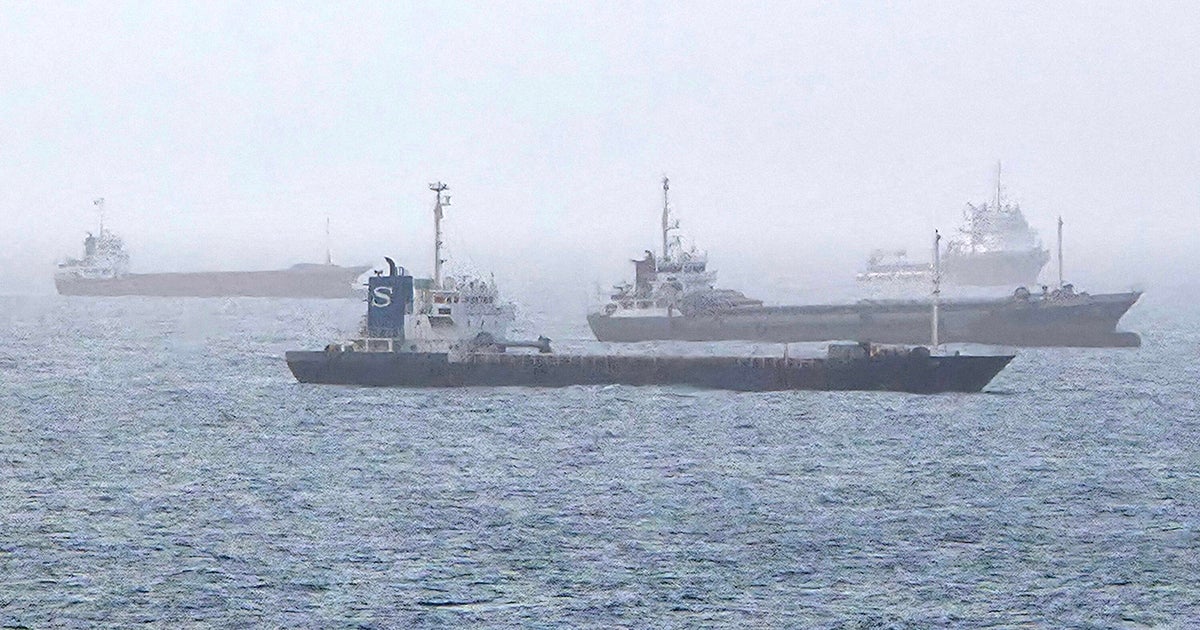
Iran's Revolutionary Guard's navy stopped six vessels trying to transit the Strait of Hormuz through routes not approved by Iranian authorities, state television reported on Monday.
"Last night, six vessels that attempted to transit through a route other than the designated one were stopped by the IRGC Navy with warning shots and turned back," a state television correspondent reported from the Gulf.
Earlier, state TV had said one was involved in an "incident," without elaborating.
On Saturday, the Guards said they'd stopped four vessels that were trying to transit through the southern part of the strait after firing warning shots.
Iran has effectively blockaded the Strait of Hormuz since the start of the Middle East war in late February.
More than 400 U.S. service members have been flown out of the Middle East for various types of treatment since Operation Epic Fury began, a U.S. official told CBS News. However, most cases were not combat-related, the official said.
Operation Epic Fury, the military campaign carried out jointly by the U.S. and Israel against Iran, started Feb. 28.
Iran's Foreign Ministry spokesperson, Esmail Baqaei, said on Sunday that the Strait of Hormuz's status remains unchanged, as Iranian and Omani officials continued talks to manage the safe transit of ships through the waterway that passes between both countries.
Baqaei said the talks had made progress. They took place after Tehran asserted that its interim deal with the U.S. allows it to manage shipping in the strait for now, and objected to U.S. efforts to support a route through the strait that passes close to Oman instead. The strait was considered an international waterway before the war.
The U.S. military on Saturday said its recently reimposed naval blockade against Iran continued, with a dozen commercial ships redirected, two disabled and two boarded. U.S. forces "remain highly vigilant, focused, lethal, and ready," it added.
Discussions between Iranian officials and their Omani counterparts over the last two days have been constructive, one Iranian official told CBS News on Sunday. Talks to reopen the Strait of Hormuz are also moving in a positive direction, the official said.
This diplomacy aims to reopen waterways around the Strait. It's directly linked to the U.S. halting strikes on Iran for the last two consecutive nights, although President Trump and Defense Secretary Pete Hegseth say the Strait is open already, and the U.S. controls it.
The U.S. Central Command paused bombings Friday and Saturday after 13 straight days of strikes. Tehran also paused bombings on Sunday.
U.S. Ambassador to the United Nations Mike Waltz told "Face the Nation with Margaret Brennan" on Sunday that the pause was aimed at "giving diplomacy some space."
"It's giving diplomacy a little bit of time. The president tried diplomacy last year, tried it this year. He is a president of peace. He is giving diplomacy a chance," said Waltz, who added that the U.S. will gauge how things are going in the coming days. "Make no mistake, assets, additional military assets, are moving into the region. The regime should believe the president when he says they're locked and loaded."
In a letter dated July 10, Mr. Trump gave formal notification to Congress that hostilities against Iran resumed on July 7.