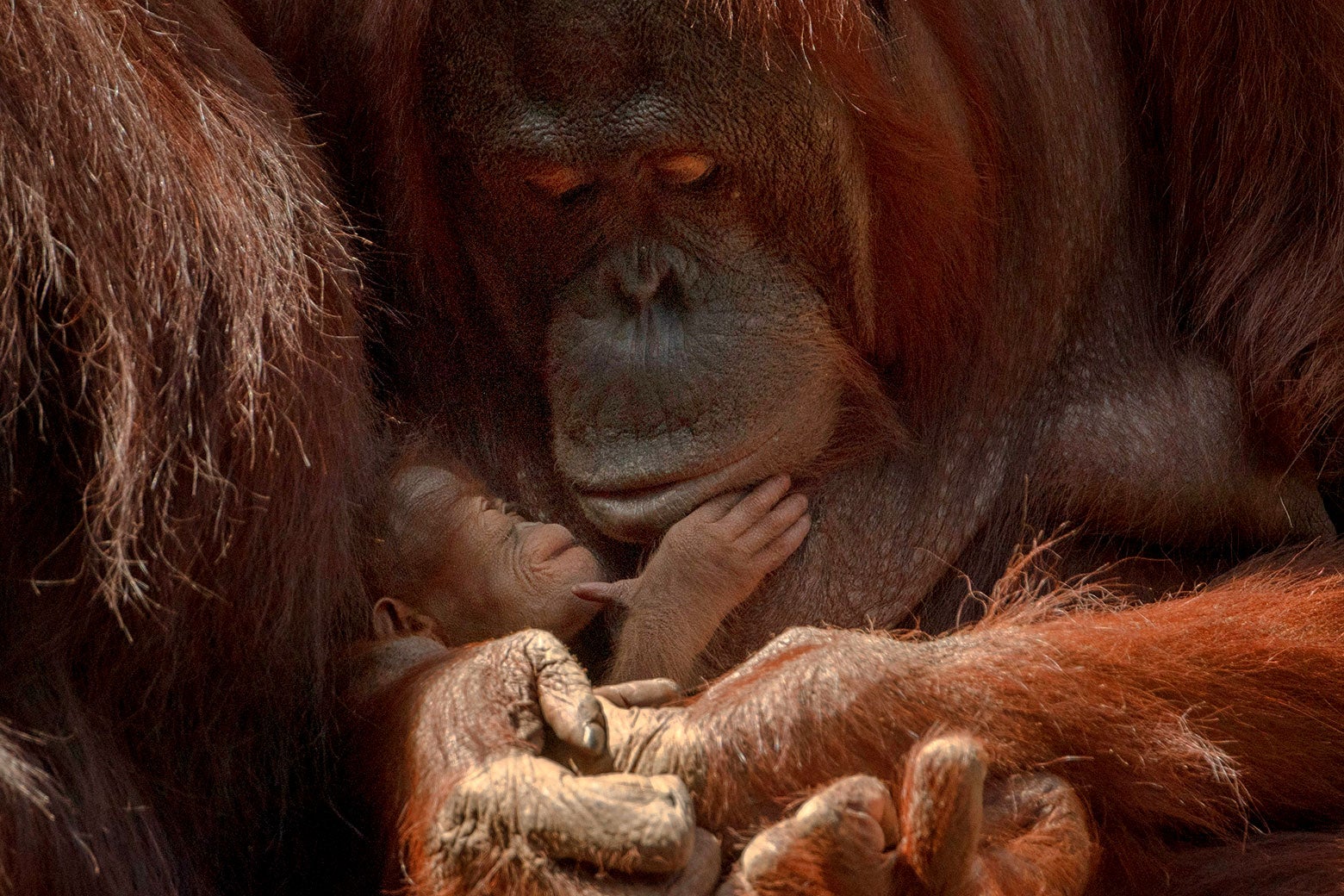
Orangutans are a little bit like tradwives. An orangutan mom doesn’t have a partner to make dinner or put on a dress for—orangutans live mostly alone—but she does handle all the homemaking and childcare herself. Her kids may breastfeed until the age of 8. But unlike the tradwife with her gaggle of youngsters underfoot, the orangutan mother sustains this intense caretaking by spacing her kids seven or so years apart.
When it comes to other great apes, the moms also get almost no help in raising their children—from dads, or anyone else—and they space their kids several years apart. Their families look even less like a “traditional” human family: Chimpanzees, bonobos, and gorillas live in promiscuous groups.
If our closest animal relatives aren’t helpful models, what is a human family supposed to look like? Modern Western parents have been taught that the ideal, natural family means a beleaguered mom plus a partner who may or may not equally share the work of raising kids. If we feel exhausted trying to follow this model, maybe that’s because it isn’t natural to our species at all.
In recent decades, many biologists and anthropologists have come to view Homo sapiens as what’s called a “cooperative breeder.” This means our species parted ways with the other great apes, and evolved for kids to be raised not by one or even two parents, but by parents plus helpers. The helpers could be grandparents, older siblings, or other relatives or community members. Such helpers are called alloparents, for “other” parents. The word was first published by Sarah Hrdy, a primatologist now retired from the University of California, Davis, who argued that this is the only way we could have started birthing our big, needy, slow-developing babies closer together (when we’re not using birth control) than any of our closest animal relatives do. At some point, our ancestors began living in groups that weren’t only companions, but co-parents.
Although there aren’t any other cooperative breeders among the great apes, there are South American treetop monkeys called marmosets and tamarins who do cooperate to raise young. These moms usually give birth to twins. A mom generally lives with a group that includes her partner or partners and their children, who stay home into adulthood (about age 1½, for marmosets). When infants are born, the adults pass them around constantly.
Those helping hands let the mothers raise lots of kids—these monkeys reproduce as often as twice a year. And in at least one species, the cotton-top tamarin, moms who have less available help are more likely to reject their infants than their counterparts who are parenting with a group are. Rather than struggling with little support, they simply don’t try to raise the babies.
Cooperative breeding is a strategy that’s arisen across the tree of life. Take an Australian bird called the white-winged chough. (Chough is pronounced chuff, and the bird is, confusingly, almost all black, with blood-red eyes.) These birds live and breed in groups of up to 20. Without at least four birds working together to raise young, their slow-developing chicks won’t survive long enough to leave the nest.
The helpers in a group are often offspring from earlier years who stayed with their parents after growing up. Sometimes, though, the birds recruit new helpers by kidnapping other groups’ young. As a recently fledged bird hops around on the ground, unfamiliar choughs swoop down and gently herd it away to join them—that’s how desperate these birds are for helpers.
In Africa’s Lake Tanganyika, fish called daffodil cichlids also work together to raise their young. One monogamous pair lives with up to 30 helpers, who defend the territory, dig shelters in the sand, and keep the eggs clean.
The creatures I’m mentioning here aren’t flukes in the animal kingdom. I learned about all kinds of cooperative parents while researching the evolution of caretaking for my new book, The Creatures’ Guide to Caring. There are cooperatively breeding insects, rodents, and even reptiles.
One of the most familiar cooperative breeders to a human audience might be the meerkat, thanks to the documentary series Meerkat Manor. The show featured a long-term research site in the Kalahari Desert run by Tim Clutton-Brock, an evolutionary biologist retired from the University of Cambridge. Clutton-Brock has joked that his most important discovery was meerkats’ fondness for hard-boiled egg. In exchange for crumbs of egg, wild meerkats will climb onto scales and even hold still for ultrasounds. This agreeableness has given scientists deep insights into their social lives.
Meerkats live in underground colonies in southwestern Africa. An alpha female and male live with relatives who are discouraged—sometimes harshly—from reproducing themselves. (Imagine if your mom didn’t ask hopeful questions about when you were going to have kids, but instead harassed you so much that the stress made you infertile.) The helpers look after the pups, nurse and feed them, protect them from predators, and even teach them how to eat a scorpion safely.
Helpfulness is a spectrum, and scientists don’t all agree about which animals should be defined as true cooperative breeders. Clutton-Brock calls the meerkats “extreme” among mammals. The cooperation between our human ancestors may have been more flexible, without rigid rules about who was allowed to reproduce.
Yet we can learn some things from meerkats and the other animals who raise their young together. For instance, maybe humans today sense that the kind of parenting we strive for is unnatural. Maybe they’d consider having more children if they felt certain they’d have support in raising them.
Adjusting your reproduction to your circumstances is only natural. Meerkats, too, grow their families differently under different conditions.
In the more than three decades that Clutton-Brock has been watching the Kalahari meerkats, he’s seen their habitat get hotter. The heat and fluctuations in rainfall affect reproduction. “In really dry years, no one breeds,” he says. “Or if they do breed, they’re very likely to lose their pups.” Fewer pups means the groups get smaller over time, and there are fewer helpers available when mothers do give birth.
Fewer Americans than ever before are having babies. In a 2024 Pew poll, more than a quarter of younger adults who don’t plan to have kids said concern for climate change or the environment was a major reason. Thirty-eight percent cited other concerns about the state of the world.