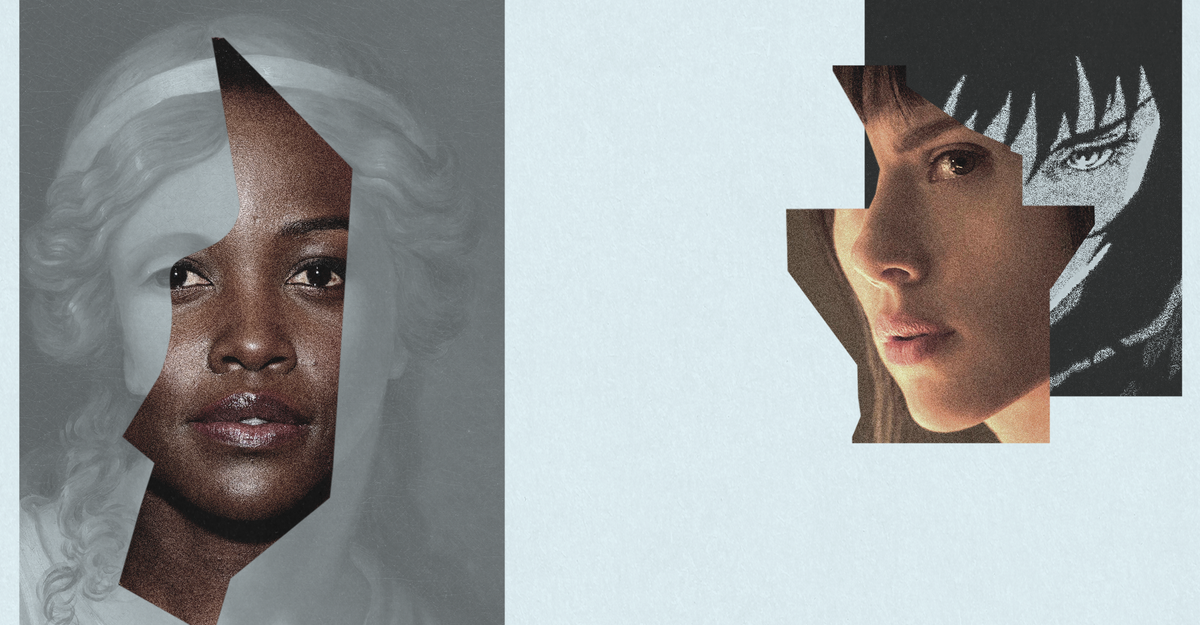
Elon Musk’s outrage at Christopher Nolan says more about today’s myopic notion of identity than it does about classical antiquity.
A beautiful movie star is cast in a beloved story. The character is fictional—she isn’t even fully human. Nonetheless, activists and purists insist that the actor is the wrong race.
I’m speaking of Scarlett Johansson in Ghost in the Shell, the 2017 film adaptation of a popular Japanese manga series. Critics accused the movie’s creators of “whitewashing” the heroine, a cyborg whose physical form is entirely prosthetic and whose race and gender are, in fact, mutable. She’s implanted with the consciousness of a Japanese woman, but her memories have been suppressed and edited. The story is an examination of how unstable identity is, and how untethered it can be from the body. Yet for detractors, the politics of representation—the simple fact that Johansson isn’t Asian—overrode the power of the film’s philosophical inquiry.
Audiences are willing to suspend all manner of disbelief in service of a good story—except, apparently, when it comes to race. Hence the controversy surrounding this year’s most anticipated movie, Christopher Nolan’s adaptation of The Odyssey. The director cast the Kenyan Mexican actor Lupita Nyong’o as Helen of Troy, the most beautiful woman of the ancient world. The resulting fury says much more about today’s myopic understanding of identity than it does about classical antiquity.
Elon Musk used to be a fan of Nolan’s, but he quickly reconsidered when rumors began circulating that the director had cast Nyong’o. “Chris Nolan has lost his integrity,” Musk said on X in January. Then, earlier this month, the right-wing provocateur Matt Walsh rekindled the debate. “Christopher Nolan knows that he would be called racist if he gave ‘the most beautiful woman’ role to a white woman,” he said on X.
Musk has been posting about it ever since. “Chris Nolan is pissing on Homer’s grave,” he wrote. “Chris Nolan has shown total contempt for the Greek People.” These complaints have garnered tens of thousands of likes and reposts. Yet Musk doesn’t seem terribly bothered by Matt Damon’s role as Odysseus, despite the actor’s lack of Mediterranean ancestry.
Such selective indignation relies on an idiosyncratic reading of Greek myth. In the most famous telling, Helen of Troy is not born but hatched. Zeus appears to Helen’s human mother, Leda, under the guise of a swan. After a sexual encounter, Leda lays eggs. Out comes Helen (and her sister Clytemnestra, also played by Nyong’o). Which is to say, Nolan’s critics seem to be committing themselves to the idea that Zeus—the god of gods; the onetime waterfowl—was “white.” His offspring, therefore, could not possibly be portrayed by someone with dark skin.
The particulars of this argument are absurd, but they’re ultimately beside the point. Art’s great gift is to allow us to transcend divisions of language, color, and nation, even of time and place—to imagine ourselves in lives other than our own. I do not need to be Russian or to see myself physically mirrored in Ivan Karamazov to be transported to Dostoyevsky’s world. Indeed, I can identify with Ivan on a far deeper level than that of blood and skin, which “do not think,” as Ralph Ellison observed.
Thomas Chatterton Williams: Saving classics from identity politics
American audiences risk squandering that gift by obsessively policing the boundaries of racial identity. This pathology spans the ideological divide. Right-wing identitarians are quick to condemn progressive hysteria about racial representation and cultural appropriation. Now they’re aping the flawed thinking they claim to despise.
The Nolan controversy seems to have inspired particular fervor because of The Odyssey’s exalted place in the Western canon. Some progressives dismiss the canon as a collection of dead white men—yet another result of hyper-racialized thinking. By contrast, many on the right have tended to emphasize that it speaks to the universal human condition, regardless of race. The canon’s champions have seen clearly how works such as The Odyssey reveal the perverted logic of racial-line drawing. Today, they would do well to heed their own wisdom.
*Illustration sources: Heritage Images / Getty; Theo Wargo / Getty; Photo 12 / Alamy; TCD / Prod. DB / Alamy.