It’s time for tributes to leave the great-man theory of history behind.
Almost every day, I drive along a street named after Cesar Chavez, past a mural of Cesar Chavez that shows the labor leader, who died in 1993, clutching the billowing flag of the United Farm Workers with one arm and a group of anonymous laborers with the other. For years, I’ve been struck by the work’s ardent theatricality: Chavez appears sturdy and powerful, whereas the figures look like they’ve fainted. In Los Angeles, where I live, Chavez is everywhere. Within a mile of that mural are two others. A multitude of municipal sites, both grandiose and mundane, bear his name. The transfer station downtown where I wait for the bus is named for Chavez. So is a city park in San Fernando, on the northern fringes of L.A., where a naturalistic bronze statue always looked as if it was about to break into a rally speech.
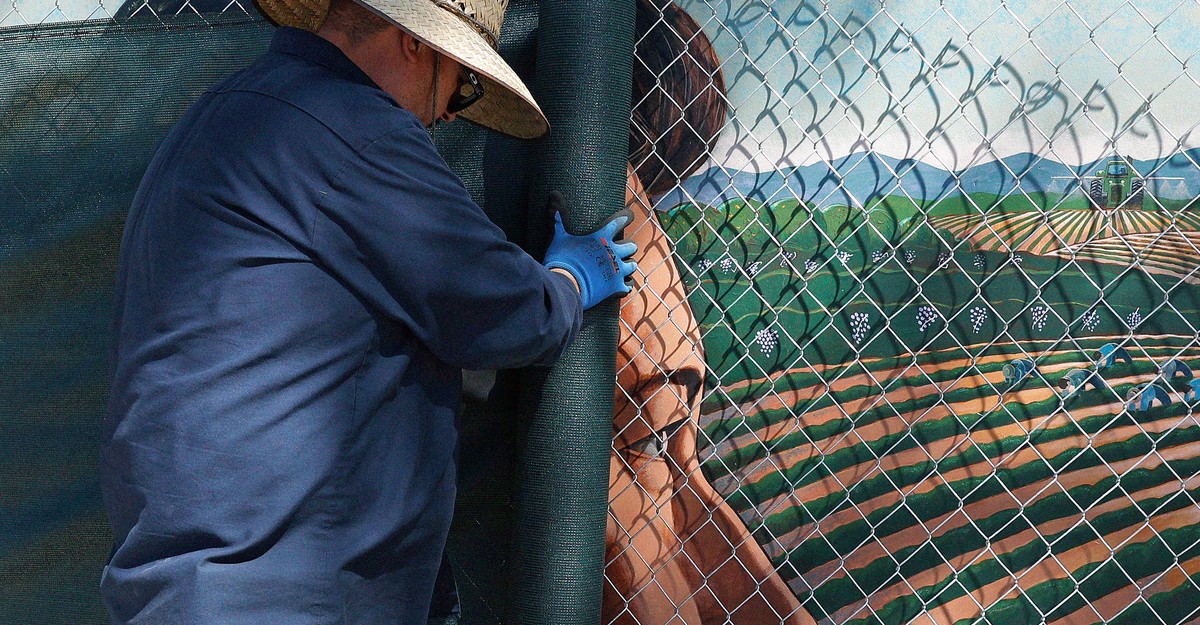
I now look on those tributes with horror and dismay. Late last month, The New York Times published an investigation that detailed harrowing allegations of sexual abuse by Chavez, including the grooming and assault of minors. Chavez’s longtime colleague Dolores Huerta alleged that he had raped her. The response has been swift: Statues, monuments, and murals of Chavez have been obscured or removed—including the bronze in San Fernando, which was wrapped up and carted away the day after the Times story ran. California lawmakers also scrapped a state holiday in his honor, replacing it with the more inclusive “Farmworkers Day.” For now, Chavez’s name still clings to libraries, schools, and streets. But this difficult process highlights all of the ways in which memorializations of the farmworker movement have missed the mark. The focus has frequently been on Chavez—at the exclusion of the many organizers and workers who helped make the UFW’s campaigns to raise working standards a success. No movement is built by one man alone.
The reassessment of Chavez coincides with a volatile debate over public memorials and the forms they take. We live in a reactionary moment: The Trump administration has resuscitated a monument to a Confederate general in Washington, D.C., and installed a statue of Christopher Columbus on the White House grounds, while generally promoting a vision that prizes the heroic and the classical. (Think: man on a plinth.)
But this is also a time when communities and designers are radically reimagining what a monument can be. In 2022, a project honoring the Navajo Nation dispensed with the usual statuary in favor of hiking trails woven around Dinétah, the territory that marks the traditional Navajo (Diné) homeland. “Some monuments are not entities that we as humans have to build,” the artist and curator Sháńdíín Brown wrote of the project, “but something that the creator has already gifted to us.” The removal—and possible replacement—of tributes to Chavez will be fraught; it will also open up possibilities.
No matter what happens next, Chavez’s vanishing profile leaves a gap that won’t be easily filled. A 2021 study published by Monument Lab, a nonprofit research-and-design studio, showed that among the top-50 historical figures most frequently honored with memorials in the United States, there is not a single U.S.-born Latino. The highly visible Chavez has therefore been an important symbol around which to rally. “He’s part of the iconography of the 1960s,” Eric Avila, a cultural historian who teaches at UCLA, told me. “Bobby Kennedy, Cesar Chavez, Martin Luther King Jr., Malcolm X—there is this canon of people we study as symbols of different social movements and symbols of that time in American history. And for Mexican Americans, Chavez became that figure.” Chavez’s fall from grace feels especially shocking today, when policy makers are targeting immigrants, and violent ICE raids are a staple of social media. “It hurts to think about the victims,” Avila said. “It also hurts to think about this gaping absence in the iconography of a movement.”
As the memorials come down, some people have called for replacing images of Chavez with those of Huerta. Muralists in L.A. and Philadelphia have already done so on existing artwork, painting over the disgraced leader with depictions of his former colleague. Huerta has publicly stated that she doesn’t want streets and buildings named after her, and that memorials should instead focus on “UFW martyrs, organizers, farmworkers, and families who sacrificed everything to build something bigger than any one person.” Huerta deserves her flowers—she was an important coordinator of the nationwide boycotts that made the UFW effective. But she’s right. Now is the moment to reconceive such tributes entirely.
And that begins with asking the right questions. “It’s not just who is deserving of a monument, but how do we commemorate, and how do we reflect history to its fullest capacity?” Paul Farber, the director of Monument Lab, told me. “If you have a vision of power that is expansive, collective, from the ground up, you will see the need to make monuments not just to the singular figure, but to put that figure in the context of how they were elevated.”
Substituting one bronze for another does not necessarily achieve that. In fact, it might even perpetuate the elisions of the past. The 1965 Delano grape strike, for example—an event that helped spark the modern farmworker movement in California’s Central Valley—wasn’t led by Chavez and the UFW; it was organized by the Agricultural Workers Organizing Committee, a union made up primarily of Filipino workers and led by the Filipino organizer Larry Itliong. Also crucial to the history of the movement was the work of Bert Corona, the founder of the activist group Hermandad Mexicana Nacional, which fought for the rights of undocumented workers—something the UFW initially resisted. (At one point, Chavez even launched an “Illegals Campaign” that encouraged union members to report “wetbacks” to immigration authorities.)
Organizers such as Corona and Itliong should certainly be remembered. (In 2024, a park in Delano was named for the latter activist, a belated recognition.) And communities will likely continue to erect tributes to such individuals, because personal histories are powerful tools for storytelling. But even those types of monuments can be designed in ways that incorporate other stories. The bronze statue of Chavez in San Fernando, for example, was accompanied by a mural that featured workers and other activists.
“Especially when we’re talking about labor and social movements,” Farber said, “how do you make room for more protagonists?” This question should be asked more broadly. Martin Luther King Jr. is the fourth-most-popular subject of monuments in the U.S., according to the Monument Lab audit; he is a potent symbol of the collective fight for Black civil rights. Yet in many places, he is depicted alone. King deserves to be honored for his work. But in focusing exclusively on him, the designers of those tributes have left out the other activists who made his gains a reality—including Bayard Rustin, who helped plan the 1963 March on Washington. A memorial based on the great-man theory of history is a tale only half told.
There are elegant ways to pay tribute to groups of people. Maya Lin’s groundbreaking Vietnam Veterans Memorial, unveiled in 1982—a minimalist, V-shaped black-granite wall cut into the land—sought to honor not an individual soldier or general but all of the war dead. (It’s powerful not just for what it does—listing names—but for what it is: a scar on the earth.) More recently, a pair of remarkable monuments to labor have taken like-minded approaches. Completed in 2020, the Memorial to Enslaved Laborers, at the University of Virginia, consists of an austere granite circle, open on one end. Carved within are the names of those who were forced to work at the institution; for people whose name remains unknown, a small line cut into the granite creates a record of their existence. And at Bryn Mawr College, outside Philadelphia, a 2025 design by Nekisha Durrett transformed a campus courtyard into a site of remembrance. The work consists of looped footpaths with paving stones that bear the names of the Black people who once labored at the college. The paths echo underground servant tunnels to which those workers’ travels were often confined. At night, some of the stones are illuminated from within, creating a sparkling, lantern effect. There are also monuments that push at the boundaries of what a monument is: the Ireichō, which first went on view in 2022, is a book that contains the name of every person of Japanese ancestry incarcerated by the U.S. government during World War II.
In 2012, President Obama traveled to Keene, California, to announce the creation of Cesar E. Chavez National Monument, which protects the bucolic 116-acre site in the Tehachapi Mountains where the UFW once maintained its headquarters. Known as La Paz, it is where Chavez is buried and his office preserved, complete with its original furnishings. It’s also—chillingly—where some of the sexual abuse is reported to have taken place. Less than a week after the Times published its exposé, two Republican senators, John Cornyn and Bill Cassidy, introduced a bill to close the park.
A better tactic would be to reimagine the monument to tell a more complete story about the farmworker movement—and about Chavez. “It’s a super complicated story, and the complexities have been glossed over,” Avila said. “It’s a good thing that we are reckoning now with the real history, which is not as pretty as we would like it to be. But that’s what history is.” In this case, the history is ongoing; farmworkers still face low pay and punishing working conditions aggravated by climate change, often laboring through toxic wildfires and extreme heat. The movement was—and is—much bigger than Chavez. It’s time the monuments caught up to that vision.