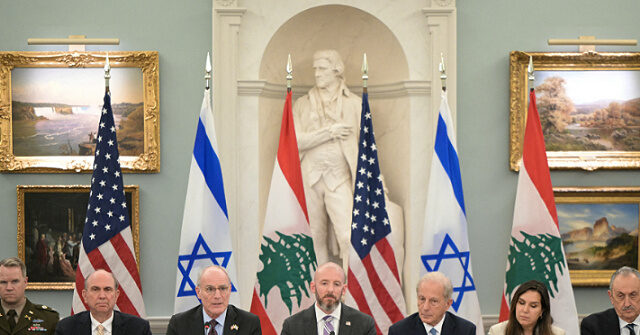
Israel and Lebanon agreed Wednesday to implement a U.S.-brokered ceasefire framework contingent on Hezbollah ending its attacks, withdrawing operatives from southern Lebanon, and allowing the Lebanese Armed Forces to assume exclusive control over newly proposed security zones, as Iran simultaneously warned that renewed Israeli strikes on Beirut could trigger a “full-scale resumption” of the broader regional war.
Following two days of U.S.-mediated talks at the State Department, Washington, Jerusalem, and Beirut issued a joint statement announcing that the ceasefire would require “a complete cessation of Hezbollah fire” and the evacuation of all Hezbollah operatives from areas south of the Litani River, while establishing “pilot zones” in which the Lebanese army would exercise exclusive control “to the exclusion of all non-state actors.”
“These steps will enable progress towards a comprehensive peace and security agreement,” the statement read, while further emphasizing that “the future of the relationship between Israel and Lebanon must be decided by the two sovereign governments” and rejecting attempts by “any state or non-state actor” to “hold Lebanon’s future hostage” — a clear reference to Iran and its Hezbollah proxy, which has sought to tie the Lebanon conflict to ongoing negotiations between Washington and Tehran over the broader regional war and Strait of Hormuz crisis.
The agreement followed days of mounting tensions along the Israeli-Lebanese border, including continued Hezbollah rocket and drone attacks on northern Israel, Israeli airstrikes in southern Lebanon, and threats from Jerusalem that additional Hezbollah attacks on Israeli population centers could trigger expanded Israeli operations in Beirut’s Dahiyeh district, Hezbollah’s stronghold in the Lebanese capital.
Iranian Foreign Minister Abbas Araghchi warned Wednesday that any renewed Israeli military action against Beirut would lead to a “full-scale resumption” of the war, insisting that Tehran viewed the Lebanon conflict as inseparable from ongoing negotiations surrounding the broader Iran war and the Strait of Hormuz crisis.
“The fate of the war between Iran and the Zionists and Americans is inseparable from the fate of the battle in Lebanon,” Araghchi declared in an interview with the Hezbollah-affiliated Lebanese outlet Al Mayadeen. “Any attack on Beirut will have grave consequences.”
President Donald Trump, however, publicly pushed back on Iran’s efforts to link the two fronts, telling reporters Wednesday that he wanted negotiations involving Lebanon handled separately from ongoing talks with Tehran.
“I’d like to separate it,” Trump said. “I’d like to have a separate thing because it is separate.”
Trump has repeatedly expressed optimism that negotiations with Tehran could still produce a broader agreement ending the broader regional conflict and reopening the Strait of Hormuz, stating Wednesday that a deal could be finalized “fairly quickly,” potentially even “over the weekend,” while continuing to insist that Iran would “never, ever have a nuclear weapon” under any final agreement.
The latest agreement came after a previous U.S.-brokered ceasefire reached in April largely unraveled amid continued Hezbollah rocket and drone attacks and expanded Israeli military operations aimed at degrading Hezbollah infrastructure and securing northern Israel.
Israeli officials maintained during the latest round of talks that Hezbollah had continued attacking Israel despite earlier understandings reached through Washington.
“Hezbollah did not stop fighting,” senior Israeli officials involved in the negotiations reportedly told their American counterparts during the talks.
The framework also appeared aimed at creating a longer-term security architecture inside southern Lebanon by gradually replacing Hezbollah influence with direct Lebanese military control.
The joint statement announced that the United States would assist in facilitating the establishment of the proposed “pilot zones,” where Lebanese forces would assume exclusive authority over the territory.
Secretary of State Marco Rubio said Wednesday that Washington hoped the talks would produce “an action plan on a track for security in Lebanon, independent from Hezbollah.”
The agreement further stated that all parties condemned “Iran’s attacks on countries in the region, and ongoing activities that undermine stability throughout the Middle East, whether through support for proxies and all other acts of aggression.”
Israeli officials have increasingly argued that Hezbollah’s military infrastructure and Iran’s broader regional proxy network represent the central obstacle to long-term stability along Israel’s northern border.
Speaking on Wednesday during a visit to the Haifa Naval Base, IDF Chief of Staff Lt. Gen. Eyal Zamir stressed that despite the diplomatic developments, Israeli forces remained prepared to continue military operations if necessary.
“In Lebanon, there is no ceasefire for our forces,” Zamir declared. “We are working to maximize the freedom of action that has been granted to us and will seize every opportunity to remove threats to the citizens of Israel and to our forces.”
The Israeli military has said Hezbollah has fired thousands of rockets and hundreds of drones at Israeli territory and IDF positions since March, while Israel has carried out expanded operations targeting Hezbollah infrastructure and operatives throughout southern Lebanon.
The sides are expected to reconvene during the week of June 22 for additional political and security negotiations aimed at advancing toward what the United States described as a broader “comprehensive peace and security agreement.”