The Supreme Court handed down a perplexing 5–4 decision on Thursday in Hamm v. Smith, a dispute over capital punishment that was poised to be one of the most important cases of the term. The majority dismissed Hamm as improvidently granted, sparing the life of the defendant, Joseph Smith, and rejecting Alabama’s request for freer rein to execute intellectually disabled people. Four justices dissented, hinting at a sharp conflict behind the scenes over the case’s potential to forever diminish constitutional protections against cruel and unusual punishments.
On this week’s Slate Plus bonus episode of Amicus, co-hosts Dahlia Lithwick and Mark Joseph Stern discussed the decision and what it signals about the Roberts court, the death penalty, and the current state of jurisprudence around executing mentally disabled defendants. An excerpt from their conversation, edited for length and clarity, is below.
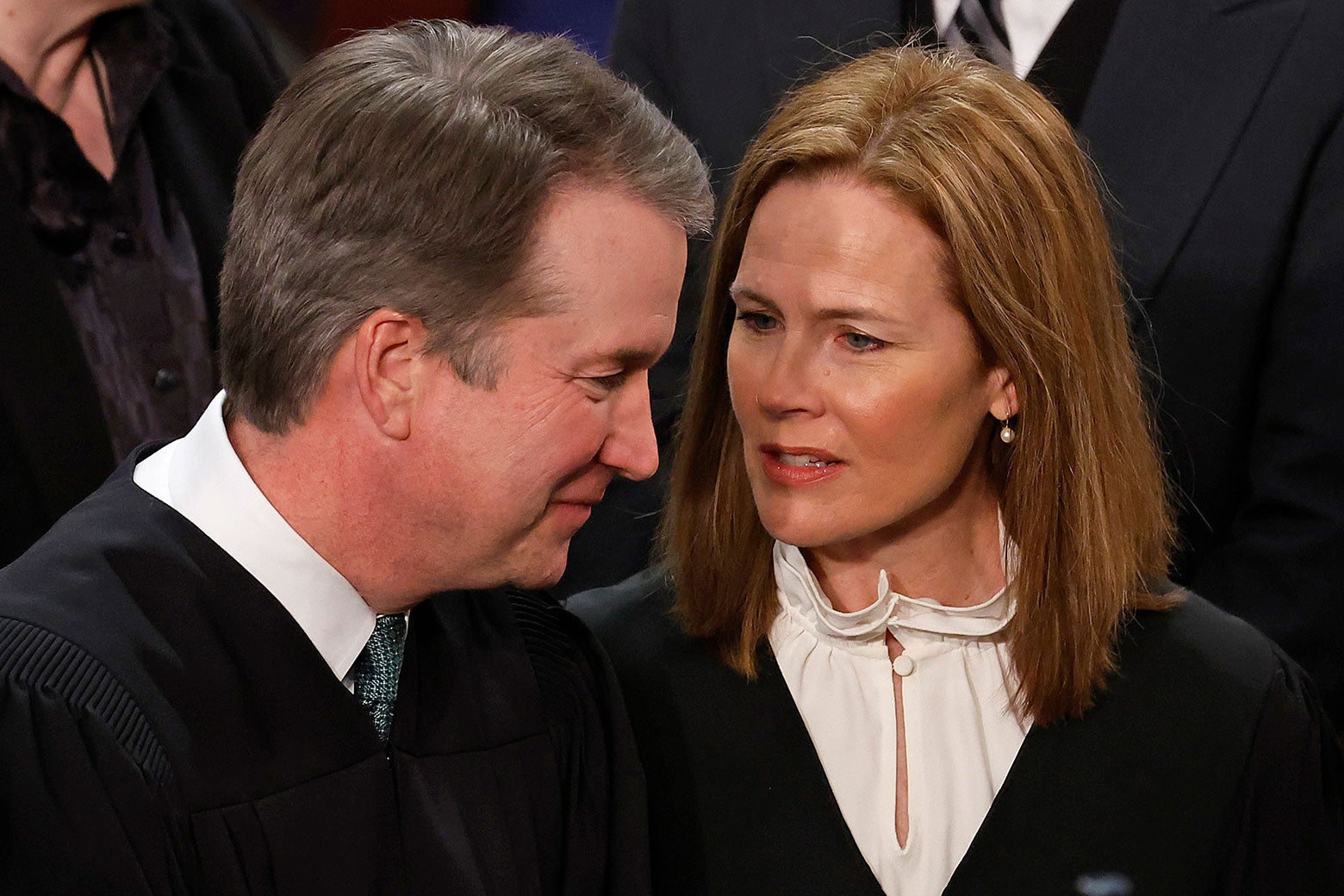
Dahlia Lithwick: This result was a surprise: Justices Brett Kavanaugh and Amy Coney Barrett joined the three liberals for that 5–4 vote to simply dismiss the case. And then we have the other conservatives very vocally dissenting. Remind us why the court took up Hamm in the first place?
Mark Joseph Stern: The Supreme Court held 25 years ago that it is cruel and unusual punishment in violation of the Eighth Amendment to execute intellectually disabled people. It left states leeway to define who is intellectually disabled but did clarify that an individual with an IQ under 70 is generally going to qualify. In this case, Smith had multiple IQ scores, ranging from 72 to 78, with a margin of error down to 69. The lower court combined that lowest score of 69 with a more holistic review to conclude that he was intellectually disabled. The Supreme Court seemed to take this case to overturn that decision; this is a conservative supermajority that has pretty vigorously supported capital punishment in most instances. I really thought the supermajority would let states define intellectual disability however they choose and give states so much discretion that they could effectively disregard constitutional safeguards. But that didn’t happen.
Instead, the majority just tossed the case. Joseph Smith, the defendant will not be executed. That’s a big win in a death penalty case before this court. But I guess the burning question is: Why did Amy Coney Barrett and Brett Kavanaugh team up with the liberals to spare his life, and do so by just kicking the case to the curb? And I know the answer is not because it’s a 3–3–3 court and they’re the neutral centrists.
It’s a really weird outcome, not at all in line with what I expected. But based on oral arguments, I think this may be yet another case that crashed into the shoals of Alabama’s terrible lawyering. Alabama wanted the court to adopt a theory that would allow states to weigh multiple IQ scores any way they wanted to get above 70. It actually argued that states should be allowed to only count the highest score and ignore the lowest. But the state’s lawyers couldn’t present a coherent theory as to why; they couldn’t actually explain: Here is exactly what we think states should do when weighing multiple IQ scores. They just argued that they should be able to do whatever funny math they needed.
Both Barrett and Kavanaugh seem frustrated with that approach during arguments. I think they realized that this was litigated very poorly, and Alabama was just looking for an excuse to kill whomever it wanted. It couldn’t explain whether it wanted to count the mean or the median or the margin or error or something else. That meant this case was no longer going to be a clean vehicle to decide what the IQ line needs to be for intellectual disability under the Eighth Amendment. So they just joined with the liberals to say: We’ll deal with it another time. Clearly, this is just a reprieve, but it does show a good sense from Kavanaugh and Barrett that they didn’t take this mess and try to create a clean constitutional rule out of it.
But we have this dissent by Justice Samuel Alito, joined by Chief Justice John Roberts, Justice Clarence Thomas, and Justice Neil Gorsuch. They were happy to take this mess and use it to make strong arguments against the Eighth Amendment. This was pretty close to going 5–4 the other way.
Yes, and then we have Justice Clarence Thomas arguing in a separate dissent that, actually, the Eighth Amendment poses no bar to the execution of intellectually disabled people, and the court should overrule 25 years of precedent holding that it does. He wrote that it is perfectly constitutional to execute people who have the cognitive abilities of a young child. Roberts, Alito, and Gorsuch didn’t sign onto Thomas’ dissent. But this trio did suggest that if the court can’t articulate a clean rule about who is intellectually disabled, it may need to overturn all protections against the execution of that whole class of capital defendants. That is a bad omen, though it’s encouraging that Kavanaugh and Barrett didn’t sign onto it. The question now is: If a state can litigate this better and make a more coherent argument, will Kavanaugh and Barrett sign on then?