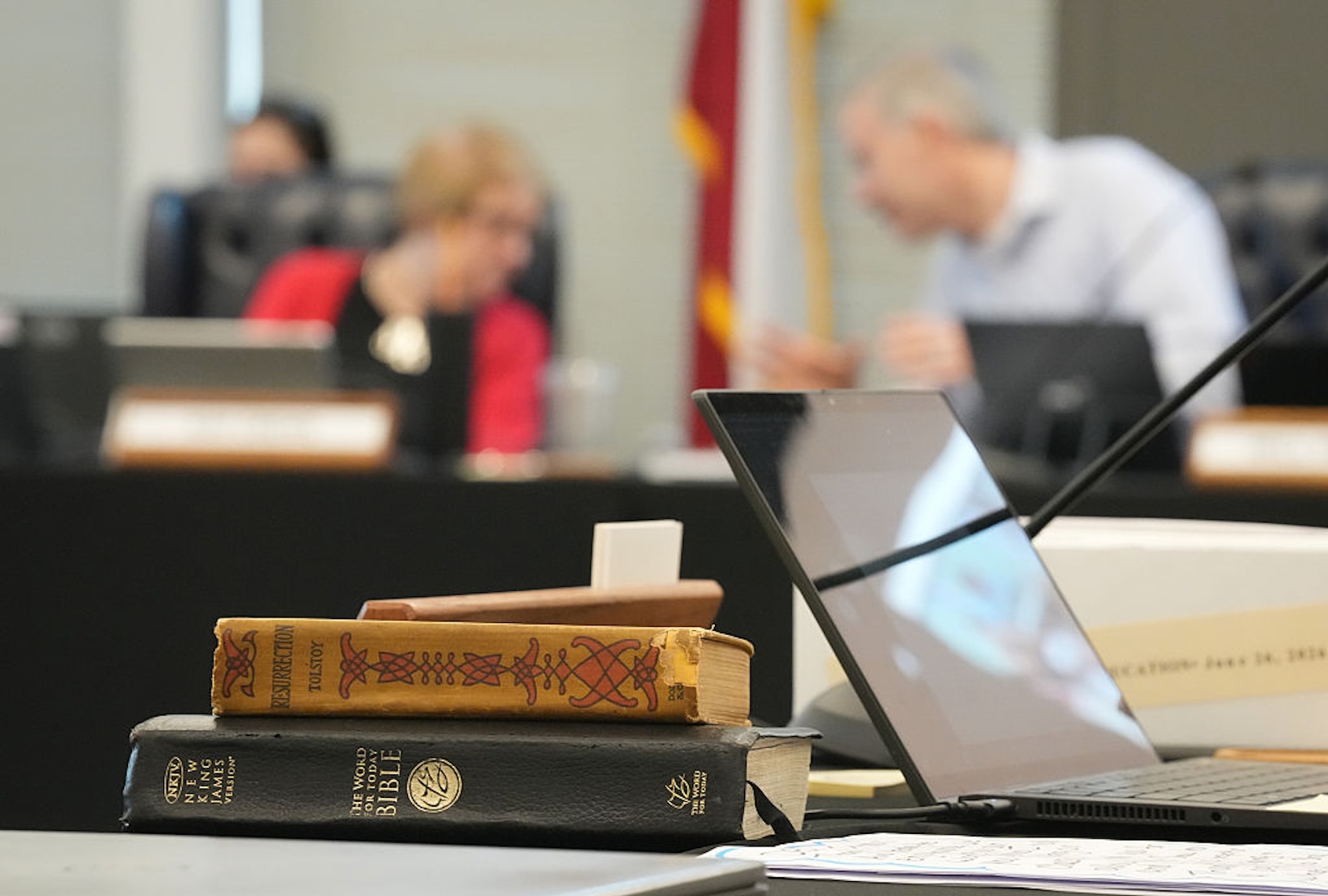
The decades-long Republican quest to force Christianity on those they see as unwashed heathens reached a new low on June 26, when the GOP-controlled Texas State School Board put Bible stories on mandatory reading lists for every level of public school student. The decision is disturbing on many levels, starting with the outright disinformation being used to justify this move by people in charge of educating children.
“Our nation was founded as a Christian nation,” board member Brandon Hall insisted during a Thursday news conference.
It’s unclear if Hall is lying or has deluded himself, but there is no excuse for indulging this falsehood about the founders, who clearly forbade the “establishment of religion” in the Constitution and repeatedly emphasized separation of church and state. It’s no surprise where this is coming from, either. The school board hired David Barton, a discredited writer who falsely claims to be a historian, as an adviser. Barton has no training and less than zero credibility, having been caught repeatedly peddling easily disproved lies. But because Republicans are pleased by his intellectually dishonest interpretation of America’s past, they continue to choose his nonsense over actual history developed by real scholars.
This is Christian nationalism in a nutshell. The use of Barton by the GOP and the Texas State School Board is not about faith or belief; it’s about power.
This is Christian nationalism in a nutshell. The use of Barton by the GOP and the Texas State School Board is not about faith or belief; it’s about power. Specifically, it’s about pushing their belief that certain people — white right-wing Christians — are the “real” Americans. In practice, it means that everyone else deserves second-class status. Forcing kids to read Bible passages signals to anyone outside the white, evangelical tribe that they don’t belong, which is a grotesque violation of American values of equality and freedom.
It’s also likely to backfire on the religious right. They better hope that the kids skip the assigned reading, much less actual discussion and debate about it in class. As many an ex-evangelical can tell you, direct exposure to what the Bible actually says is often the first step to walking away from Christian fundamentalism altogether.
There’s a reason conservative Christians prefer quoting solitary Bible verses out of context: Not only does this allow them to twist the meaning for their own personal or political ends, but it also makes it much easier to avoid the critical thinking that engaging with longer passages can provoke. On my YouTube show “Standing Room Only,” the scholar and former evangelical Brad Onishi pointed to 2 Chronicles 7:20, a passage Christian nationalists often deploy to argue that America is meant to be a Christian nation by relying on the verse’s violent implications of God promising to “pluck” the unbelievers “up by the roots out of my land.” The larger context reveals that this story is about the ancient king Solomon, and it has nothing to do with the modern nation-state, much less one on a continent unknown to the writers of the Bible.
There are countless other examples, but that one illuminates the purpose and methods of the Christian nationalists; the last thing evangelical leaders want is a curious child or adolescent to read and ask questions. In the process, students might realize that religious leaders are manipulating them. They may find that verses used to justify anti-LGBTQ+ laws sit right next to passages banning people from eating shrimp, planting your beans beside tomatoes, working on Sunday, getting tattoos or reading horoscopes. They may discover that stories promoted as literal truth, including Noah’s ark and the Garden of Eden, contradict themselves or don’t hold up to intellectual scrutiny.
It’s also worth remembering that many students — and even some teachers — aren’t Christian, which means that classroom discussions will not always been favorable to an evangelical interpretation of scripture. In short, Texas Republicans have likely created opportunities to expose Christian kids to other people’s points of view, which may not have happened otherwise.
No doubt thinking they’re clever, the school board attached many of the required Bible passages to lesson plans for other books, such as requiring the Adam-and-Eve tale as supplementary reading for Nathaniel Hawthorne’s “The Scarlet Letter,” or 1 Corinthians 13 for Jane Austen’s “Pride and Prejudice.” Both books are famously skeptical of the religious dogmatism and patriarchal values Texas Republicans hope to instill in students. Especially in classroom discussion, where students might encounter teachers or peers asking questions that provoke thought, many will align themselves with the critical thinking of Hawthorne and Austen — and not with the mindless religiosity envisioned by Republicans on the Texas State School Board.
An irony of this decision is that Texas has found itself at the center of a crisis of faith involving the false assumption of the religious right that reading the Bible turns people religious and conservative. The Senate race between Democratic state Rep. James Talarico and Republican state Attorney General Ken Paxton has been a master class in embarrassing Christian nationalists with their hypocrisy and rejection of many Bible texts they claim to venerate. A progressive Christian, Talarico often cites scripture, and especially words of Jesus that many conservatives pointedly ignore, to argue for values like compassion and empathy. The religious right has responded with an all-out assault on Talarico and his ecumenical beliefs, and they are seeking to scare their followers out of even listening to him, much less actually reading up on why progressive Christians believe that Jesus actually meant all that peace-and-love talk.
In light of the “don’t read, don’t ask questions, don’t think for yourself” response to Talarico, it’s especially odd that Texas Republicans included the Beatitudes on the mandatory reading list. These are from the Sermon on the Mount, where Jesus blesses the poor, the meek and the peacemakers, and then calls on his followers to turn the other cheek and love their enemies. Even devout right-wing Christians understand, on some level, that this passage contradicts their political worldview, as evidence by the fact that pastors across the country are facing outrage from their congregations if they read the Beatitudes. Russell Moore, who was pushed out of Southern Baptist leadership after speaking out against Donald Trump, told NPR that congregants who hear the Beatitudes in church have complained, asking, “Where did you get those liberal talking points?”
For decades now, the percentage of Americans who call themselves Christian has been shrinking, and it’s not due to a lack of exposure to religion, but the opposite. As Robert Jones of the Public Religion Research Institute told Salon in 2017, much of the decline has come from young churchgoers who have become disgusted with the incoherence and hypocrisy on display from their leaders and left. The growing chorus of outspoken former evangelicals tells similar stories of learning more about the Bible and questioning what they have been taught. This trend has been given a boost by the internet, where people experiencing doubts can go online and see true scholars debate conservative Christians — and reveal their twisted theology.
Many people go through their lives without thinking about these issues too deeply one way or another, simply accepting what they were raised to believe. While Christian fundamentalism has benefited from this paucity of critical thinking, it’s now being put for debate in ways we haven’t seen for decades — and its faith leaders haven’t liked the results.
They may like it even less if they make that debate mandatory in the classroom. The goal was to subject non-Christians to the Bible, but in doing so, they may also be forcing Christians to hear questions and criticism they were able to avoid when religion was kept outside the classroom’s doors.